
Review of The Girl Who Drank the Moon – Fantasy Novel
I believe that fantasy is the hardest genre to write, or at least to write well, particularly for those authors who have the tenacity to build an entirely new and fresh world. With limitless potential comes countless pitfalls, meaning that the selection of fantasy that can definitively be called good fantasy is, by my estimation, rather narrow. Kelly Barnhill’s The Girl Who Drank the Moon is good fantasy – but not, unfortunately, the rare great fantasy.
Evaluation
My most important qualifier for good fantasy is the world in which the fantasy is set. A good story needs a vibrant back drop with history and wonder and details that don’t have to be fully explained to be appreciated, and this is where Barnhill excels. The threading of chapters that are written as a parent telling a story to a child fleshes out the feelings of different generations in the book and explains how the world became what it is when we join the story. The consistent mention of “The Bog” and its world-building, life-giving, origin-story presence gives a rich, almost religious tone from the bog-embodied Glerk. Even the barely explained mythical process of Xan feeding starlight (and, by accident, moonlight) to children feels perfectly at home in a world that’s at least half folktale. The world just seems to fit together in a neat puzzle.
The characters are endearing – in this I find no fault. Glerk is ancient, wise, and caring, Xan is equal parts stubborn as she is helpful, and Fyrian’s dauntless, childlike spirit keeps the tale lighthearted and spirited. The list goes on. Each chapter puts a different character in the driver’s seat, but this, I think, becomes a hindrance to our experience of the story as we go. Other characters who receive distinct character include Luna, Antain, Gherland, the madwoman, and the terrifying Sister Ignatia. Eight characters across about 400 pages share the central focus, watering down each of their stories and pigeonholing them into tropes. The author hints at Ignatia’s source of sorrow, but simply leaves it at “something long ago”. There is no redemption for bad characters, and magical (not in a good way) resolutions for all the good characters. It’s clean and simple, but cuts the emotional depth of the story.
Still, the novel provides some very keen lessons without being heavy-handed, which is perfect for this age group. Xan is keen to remind us that sorrow is dangerous – but that’s only half of the lesson, or a third, depending on how you slice it. Sorrow is dangerous, but that doesn’t mean you can avoid it. And drinking sorrow is even worse for the soul. It’s a theme that’s woven so neatly into the story that you barely notice it until you reflect on it later. In this, Barnhill earns that Newberry Medal stamped to the front cover.
Response
I adored the world this book takes place in. It is so clear that the author has put a full history into that world, with betrayal and darker magic than we get to see. It just seems a shame to me that everything happening in the story skims the surface of what looks like a rich history. Picking two key characters – likely Xan or Luna, and Antain – and allowing them to dig into the world and show us all the dark and enticing secrets would have elevated this story, and likely the stakes of the conflict, to a whole new level. It’s not to say that anything the author chose to do was bad, just not above-and-beyond. But perhaps my bigger personal issue are the clean lines between good people and bad people. Antain’s plotline is the only one that even comes close to challenging that line, but that punch is ultimately pulled, perhaps for the sake of the younger audience. What a rich story this could have been if it showed us how power is dangerous – how power created all of the problems these characters face – how even power with good intentions can be abused (again, the author dances around this point early in Xan and Luna’s plotline). This book just comes so close on unlocking an amazing sense of depth and emotion that you can taste it, but it seems to hit the brakes on every exciting turn.
Conclusion
The Girl Who Drank the Moon is undoubtedly good. It’s packed full – perhaps somewhat to its own detriment – with lovable characters in an intriguing world. Though it doesn’t quite take the gloves off when it comes to challenging topics, it still deftly provides a useful lesson that will no doubt engage and entertain any young reader. 8/10
References
Barnhill, Kelly. (2016). The Girl Who Drank the Moon. Chapel Hill, NC: Alongquin Young Readers.
Onoda, Y. (2016). Cover Art for The Girl Who Drank the Moon. (Jacket Illustration). Retrieved from https://www.goodreads.com/book/show/28110852-the-girl-who-drank-the-moon?ac=1&from_search=true

Review of Long Way Down – Realistic Fiction
“Prose” and “verse” are some of those words that intrinsically put me off from something. Part of that is because I had poor poetry teachers who never explained them or their use effectively, and part of it is because of Instagram. What I unaffectionately refer to as “Instagram Poetry” tends to be a sentence
Where the author for
Some reason
Writes
Like this.
I think it’s safe to say that may experience with prose – good prose – is limited. And because of that I avoid it.
What luck it was, then, that I picked up Long Way Down by Jason Reynolds without looking inside first. I may have put it down without realizing how powerful and moving prose can be when it’s done right and when it fits.
Evaluation
There is no right element to focus on first. The language and the characters and the lesson and every part of this book complement each other so phenomenally that I stared at that blinking cursor trying to decide where to begin. I chose language simply because when I opened the first page and saw it was written in poetic form, it immediately impacted me before I knew where the story was heading.
On the first page, you do not know who this character is, or where they are, or what they’re doing. The first sentence tells you a lot: “Don’t nobody believe nothing these days.” And suddenly, you know a lot about them. They don’t trust; they don’t know people who trust. They don’t speak clean, perfect English, so either they haven’t been taught or that’s just the way their community speaks. And after this first sentence, Reynolds heaps on line after line after line that continues to show you who these people are and what this community is like without ever stating it. And once you know that the protagonist’s, Will’s, brother has just died, the prose suddenly works. The fragmented pattern of thinking, they shifted focus on certain words, the abundance of figurative language, the rhythm, everything about it just seems to reflect Will’s sense of disorientation and his efforts to cope with grief. The inserts of random thoughts and anagrams help you feel the exhaustion that fear and worry and sadness create, as distractions creep in that don’t really make sense but are also related to what’s going on. The rhythm in prose of the question
“Then
Then why
Then why you
kill him?” (Reynolds, 2017, p. 218)
captures perfectly the stammering fear and confusion inherent to the question. And the figurative language captures emotion, without breaking the immersion of listening to fifteen year old – comparing the absence of a person to a spot where a tooth used to be, or having a river of wounds, is believable yet poetic.
That same believable language courses through every character. They are rich, well-defined, and real, even when their stories are short. Buck, the first to join Will on the elevator, is not particularly close to Will, and yet his connection in all of the stories gives him a fascinating fullness. Will goes so far as to explain Buck’s two-sided-ness on account of his two fathers, one a robber and one a preacher, and Buck’s character shows both of those parts; he is kind to Will and his brother, but also a notable thief. And every character shares that clarity of life: Will’s uncle had crazy dreams but got used to the easy money of drugs, his dad was loyal to his family which lead to his demise (which his sons seem to inherit), and the others on the elevator who got mixed up in all of the fallouts become more alive with each new guest’s story. It works because it shows the self-destructive cycle that comes with inner city life and the three rules provided from the beginning.
And, of course, that’s Reynolds’s point. Stated from the back of the book, and inside of it, and in the notes on the jacket – there is a cycle of pain that comes with the inner city life that’s being passed from generation to generation. He is eloquent in focusing on the pain, rather than anger or justice or something else that may be more self-fulfilling. And, at the end of the book, he reminds us that the cycle is a choice by means of a closing question. It is, appropriately, poetic.
Response
I loved this book. I devoured it. It’s one of those rare books that’s not just for young adults, though they may stand to gain the most from it. This book is just so far removed from my experience, and my preference, and pretty much everything I know, and yet it was so deeply compelling because it is so deeply human. There were so many moments where a line struck me and quite literally gave me chills because it is raw and honest and beautiful. I realize I am ranting more than critiquing, so let me explain. I read this book four days ago and was really moved by it. I figured, I should let it rest for a bit before reviewing it so I can process it a little more clearly. Turns out, as soon as I really started thinking about it again and flipping to find my favorite pages, that emotion resurfaced almost immediately. That, to me, is an indisputable sign of great writing.
Conclusion
This is a book that makes those cliché, popular newspaper, front-cover review words go from “tired” to “actually correct” – raw, moving, powerful, “a rich tapestry of language”, et cetera, et cetera. From the first page, Reynolds pulls you into a deep, heartfelt story that is equal parts sympathy- and rage-inducing. Read this book as soon as you can. 10/10
References
Reynolds, Jason. (2017). Long Way Down. New York, NY: Simon & Schuster.
Getty Images. (2017). Cover Art for Long Way Down. (Jacket Illustration). Retrieved from https://www.goodreads.com/book/show/22552026-long-way-down?ac=1&from_search=true

Review of Tell Me Three Things – Romance
Earlier this year, I had a lengthy discussion with a student – a strong writer – about the difference between honesty and being mean. We had done peer reviews on a paper in class about a week prior, and I had graded one student’s work and had noticed that one of the main things I had instructed to check for had gone unmentioned. I checked the peer review assignment and saw that this strong writer had been very, very nice with their feedback, but had not given anything for the weaker writer to improve. When I asked her why she didn’t say anything, she said “She’s my friend! I didn’t want her to feel bad if I criticized her work.” I hope that it made sense when I told her that it makes sense to want to be kind and supportive of a friend, but that her failure to be honest left her friend in a worse position for the actual grade.
That’s all to say, I have to emphasize that the following review is meant to be honest, and not mean. After all, I have nothing personal against Julie Buxbaum. But her novel, Tell Me Three Things, leaves so much to be desired, that I might slip up and come across too harshly.
Evaluation
Character is the heart of all novels, in my estimation. The most magnificent settings and the most intricately laid plots (neither of which can be found in this novel) are nothing without the leading lads and ladies who explore them and create the strife that illuminates their grandeur. The characters here, however, seem more like the cardboard cut-out advertisements set up in a movie theater lobby. They are stiff, flat, stereotypes lifted directly out of the supporting cast of every teen movie you’ve seen. Let’s begin with our leading lady, Jessie. The first sentence on the inside of the cover isn’t wrong – “Everything about Jessie is wrong.” There is a sheer dedication to proving that Jessie isn’t like other girls, to the point that she becomes just like every other girl who isn’t like other girls. Most specifically, she dwells on how her love for her books makes her so different from everyone else. This irks me because here is a book that says, almost in plain text, “People who are skinny, blond, and sporty don’t like books” – it’s self-defeating and elitist, everything a book should not be. Even beyond that, the way Jessie talks is stiff and inaccurate to teen lingo – what 16 year old out there uses “ubiquitous” (that’s on page 33 [the first time]) while narrating their experience? It is a cycle of immersion-breaking writing that really detracts from Jessie’s character. It is too clear, to me, that this is 38-year-old Buxbaum’s voice bursting through the pages here.
Every other character here exhibits slight growth at best, but even then they’re molded from the teen romcom cookie cutter set, sometimes verging on dangerously stereotypical. The blondes are mean, and Jessie resents them. The Korean best friend is frequently mentioned to be into K-pop and her complexion is mentioned a few times too many. The slew of boys are tall, hot, and tall, as well as hot. Even the main boy, Ethan, apparently only wears Batman t-shirts, which somehow signifies that he, too, is different (I can’t help but think how this would make filming a movie go faster – but perhaps I’m projecting a bit too much at this point). Instead of challenging tropes and stereotypes, this novel reaffirms them, and I cannot believe that it’s healthy. I found myself frustrated at the end. There’s no reconciliation of wounds between teen girls, and the teen boys – who are supposedly friends and bandmates – seem to just… separate. They end apart with no real closure.
Compounding the problem of the characters being paper-thin is the seeming total misunderstanding of schools, and quite possibly of California as an entire part of the world. Early in the text, Jessie laments how her old school in Chicago just had a book closet instead of a library, with no elaboration. Her fancy private school apparently has no uniform (seems unlikely) and classes are unbelievably free-spirited. The complete lack of realism in the setting puts this book one realm farther out of significance for actual teenagers, because none of them are having a school experience like this one.
And, ultimately, I have no idea what this book is trying to even tell the reader. There doesn’t have to be some ultra-clear theme or didactic lesson for a book to be worthwhile, just something to leave the reader thinking about. The secondary (possibly tertiary) plot of Jessie’s conflict with her father seems to have a lot more intrinsic value – a father and daughter cooperatively addressing grief and change is ripe for good storytelling. But because of its distant relationship to actual plot, it’s a simple neutral-bad-good background story: Jessie feels weird but doesn’t talk about it to her father, they have a conflict which is really just a long, drawn-out silence that’s mentioned once in a while, and then they have a conversation accounting for half of a chapter that fixes almost everything, like flipping a light switch on and off. Instead, we’re treated mostly to the “conflict” of Jessie not knowing which of the three boys actually likes her or which of the three she actually likes, and at different points, it’s all of them. So despite being so different and so out of place and so unlikeable, as author and narrator like to remind us, Jessie has no issues in the romance field. It’s not a conflict so much as a game of will-they-won’t-they-whack-a-mole.
Response
It’s not really fair for me not to mention that romance is not my preferred genre, though I doubt it’s not clear at this point. But this is the kind of book that reinforces that opinion – it relies so strongly on stereotype and an unhealthy sense of vindictiveness that I have a hard time rooting for the characters, or even being interested. It looks to me like the primary function of this book is to validate the belief of readers who feel different that they are different and that people who aren’t “different” will never understand them. These books gloss over the requirement of self-reflection for growth, instead choosing to simply provide a false, glamorized view of the issues faced by people who feel like they don’t belong and who turn that into spite against people they don’t like.
I know throughout writing this I have strayed dangerously towards being outright mean towards this novel, but the more I think about it, the more frustrated I am by it. I dread thinking about having one of my students read this book and have it reinforced to them by an older author that yes, those people you think are prettier than you will be mean and cruel. Or to have an author suggest that you have little agency in most of your problems. But quite frankly, I doubt many actual teenagers are even reading this book, because there’s no way that they could believe a teenager would willingly and regularly check their email account or make references to MTV’s Cribs when it’s been off the air since 2011. .
Conclusion
I am not the target audience for this book, but I can confidently say that it misunderstands and misrepresents teenagers in an unhealthy way, and furthermore, it uses stereotyping in a way they can quite possibly be damaging to the relationships teens create. It lacks substance, and as it tries to untangle a web of conflicts, it smooths things out without demonstrating any of the real work and time these problems require for healthy healing. I cannot in good conscience recommend this book. 1/10
References
Buxbaum, Julie. (2016). Tell Me Three Things. New York, NY: Delacorte Press.
Getty Images. (2016). Cover Art for Tell Me Three Things. (Jacket Illustration). Retrieved from https://www.goodreads.com/book/show/25893582-tell-me-three-things?ac=1&from_search=true

Review of Scythe – Science-Fiction
Neal Shusterman’s Scythe was, this past year, what I like to call a revolving door book in our school library; as soon as one kid returned it, another was lined up to check it out. By the third time I saw it, I had to ask about it. They told me it’s a book about a world where natural death had been stopped, but the population was kept in check by these grim-reaper-type people who took their lives.
My thoughts then? “Huh.”
Fortunately, I gave it a go. It’s a good story that checks all the boxes that young adult readers devour in their books – a school(ish) setting, romance, excitement, good and evil, moral complexity, and, of course, gratuitous violence.
Evaluation
Shusterman’s overarching success here is in the setting. This is perhaps one of the telltale signs of an experienced author, as many of the other books I’ve read as of late have been shaky in the fleshing out of their world. The utopic world order of the books comes packaged perfectly with all the moral questions of scientific advancement – what would happen if people lived forever? If they could reset their age? If everyone was (almost) equal and had nothing to fear? It’s resoundingly relevant right now, and with digital-era teens being keenly aware of how data and information are transferred and stored, they no doubt see the possibility of the world Shusterman has built. It’s not a new concept, by any means – Bradbury’s works come to mind almost immediately – but Shusterman has adapted that concept to fit neatly with those unsettling concerns of the modern age. The notes in between chapters help push those morality questions forward while building the history of the world, and they seem to wiggle their way into relevant plot points in the story at-large. It’s a neat, interconnected, well-timed setting that simply works.
The plot, though… Well, suffice to say, there aren’t really any surprises. It follows all the beats of many other teen dystopia novels: selection, teaching, complication, trial, victory. In this novel, the two-perspective narration actually harms quite a bit of the excitement. Rowan is eventually taken in by the big bad of the book, but instead of us having to question where his loyalties lie as Citra does, we see through his eyes what he feels. It cuts the tension so drastically that by the time the big reveal happens, it falls flat. It also damages Citra’s narrative in that when we as readers see her questioning whether or not to trust him, we already know the answer. It’s not that it’s bad, necessarily, but the burning need to know whether or not Rowan will uphold his ideals or give in to the pressure from Goddard is absent, when it could have been a powerful and exciting incentive for the plot. Furthermore, despite the existence of a sequel, it feels painstakingly evident that the sequel wasn’t guaranteed at the time of publication. Despite this huge moral mess, the story ends mostly with neat bows and closed doors; all the immediate threats are taken care of and there’s a write-in at the very end for something that could solve the long-term problems. Whether from the author or publisher, this decision made the ending feel rushed and cheated after a long build-up.
And most of that build-up is dedicated to fleshing out the characters of Rowan and Citra. As youths experiencing those moral questions presented to them by their setting and by their mentors, they work very, very well for this story. They both are brought in to the Scythe fold because they are hesitant to kill and take no glory in it, but their different paths challenge their initial morality in an intriguing and frequently convincing way. Their own fear and questioning being malleable by people they see as leaders and mentors has a surprising degree of truth to it, but it’s not all that convincing – the budding romance is really quite cringe-worthy. There’s absolutely no build-up or romantic tension between these characters other than one is a boy and the other is a girl and hey, they’re in proximity to one another. So each time the romantic aspects crop up, they’re just not convincing. The big three words are said at one point near the end, and I just couldn’t wrap my mind around it. The story would likely have been better off leaving that out altogether.
Response
This is exactly the kind of book I would have read at this age – in fact it was, when I read The Chaos Walking trilogy which is extremely close in nature to this story, but in my recollection, pulled off much better – and it follows all the same beats. Some of my frustrations with it are likely there because I have read so many books like it before, and I just don’t see a lot that stands out about it. If I was a teenager who had not already read all those books, I can see why this book would be so riveting. The violence of course is a big draw, as the grittiness of it is a big contrast to lots of other books, but it’s really all down to that setting. Shusterman has recognized what young readers wonder about and turned it into a tangible plot, and really, what more could they want than that? Does this book do anything different? Not really. Does it do something valuable? Absolutely.
Conclusion
Shusterman’s gritty and dark dystopia is no doubt a riveting read for all teens, boys, girls, and others alike. It’s not entirely unique, nor is it the best in the genre, but it does accomplish what it sets out to do – recognize a modern concern and spin it into an entertaining tale. 7.5/10
References
Shusterman, Neal. (2016). Scythe. New York, NY: Simon & Shuster.
Tong, K. (2016). Cover Art for Scythe. (Jacket Illustration). Retrieved from https://www.goodreads.com/book/show/28954189-scythe?ac=1&from_search=true

Review of Furyborn – Fantasy
Any time I need to escape a reading slump, I turn to fantasy. I’ve trudged through some of Game of Thrones (the show really cut a lot of the tension out of that experience, unfortunately), I can always find a Wheel of Time book laying around, and most recently, I’ve been devouring Brandon Sanderson’s Stormlight Archives books. And, yes, I intentionally picked these three series in order to make an ultra-smooth transition into discussing Claire Legrand’s Furyborn. It’s the lovechild of all “adult” fantasy, boiled down into something new and different, and it works – well, kind of.
Evaluation
I feel obligated to address my criticisms first, though I usually prefer to open light. Legrand’s author’s note at the end of the novel indicates that she first conceived Furyborn fourteen years before its publication, and I think it shows. Stephen King encourages authors to be much more conservative with the time they dedicate to one story before it starts to become foreign, and while he’s not the final authority on writing, I do agree with this note. Furyborn as a whole tries to do too much too fast, and it seems to me that the revision process is noticeable – the last minute changes to dialogue and plot that aren’t thought out with the whole novel in mind as opposed to that moment.
The characters really get spread thin here, after an already jarring beginning. In about five hundred pages (divided between the two parallel plotlines), I can think of nearly 20 named characters who are indicated to be important, several of whom are dropped in and reappear many chapters later. On top of that, the 250-pages-per-plotline makes it difficult to engage with these characters in a meaningful way before something tragic happens to them. Imagine arriving to a dinner party as a guest of one of the partiers, and ten minutes in, one of the party-goers flips a table and leaves. Everyone else is jarred by it, and sure, you can understand why they are jarred, but you don’t share that feeling. In writing, that’s a very important distinction. One of those character deaths (or perhaps pseudo-deaths?) happens less than 100 pages into the story – again, split between two plotlines – and supposedly our protagonist cared deeply for this person. It’s just impossible for us to really tell other than the author telling us, repeatedly, that she cared.
Character motivations within the plot suffer from that thinness as well, because we are not given time to sit and think with them. They are constantly in motion, in battle, in peril. Across 52 chapters, maybe 4 of them don’t include a combat sequence, and I think each of those includes either thick romantic tension or a detailed sex scene. Legrand is lucky she’s good at writing action, but the stakes just aren’t there without chapters in between for the characters to build bridges and warm up to each other, and for the audience to get more of a feel for their hopes, dreams, fears, and growth. The constant action just skips over any development – within one chapter, one of the protagonists abandons someone to save herself AND decides to then go into a more dangerous situation in order to save that same person. Again: in the same chapter.
Last, the characters seem to face no consequences, which makes the stakes null. Every time Eliana acts selfishly or downright cruel, she is forgiven, without pause, by those around her. It’s quite the same for Rielle – she has unlimited power and constantly endangers others, but she’s always allowed to continue. The only action that ever had consequences didn’t even happen in the context of the book, just in her memories.
So, I said before, it sometimes works, but all I have done so far is lay down complaints. Despite all of these glaring flaws, something about this story just works. The bones of the story are fundamentally good, even if the meat of it is lacking. It’s not particularly original, but it has that universal fantasy appeal. Magic, power, conflict, age-old wars, glorious battles, strange connections, all of those tropes delivered with what can only be a genuine interest in fantasy to make it worth reading. It’s just simply cut too thin to be as amazing as it could be.
Response
It seems like a contradiction to be so deeply frustrated with so many elements of this book and yet enjoy it, but I here I am. Maybe it’s just my love of the fantastic mentally polishing the parts of the story that don’t shine, or maybe it’s the simplicity of the story playing out like an easy-to-watch TV show but something about the book is intrinsically fun. I know the audience for whom this was made will devour this book for all its combat and for its romantic pining (probably more for the fulfillment of that pining; the steamy encounters are enough to make a grown man blush!), so perhaps Legrand’s natural style is just good enough to keep us reading. I honestly can’t think of any ways in which this book pioneers something new for the genre, nor does it challenge anything intellectually – it’s just fun! And maybe that’s all it has to be.
Conclusion
Furyborn is a messy book. It’s full of contradicting choices, the characters are spread much too thin, and it’s an endless series of actions with little motive and littler consequence. Still, it checks all the boxes required to be a comfortable entertaining read. It likely won’t be for everyone, but teenagers cresting that age where fantasy can become raunchy will probably find it very accessibly. 6/10
References
Legrand, Claire. (2018). Furyborn. Naperville, IL: Sourcebooks, Inc.
Curtis, D. (2018). Cover Art for Furyborn. (Jacket Illustration). Retrieved from https://www.goodreads.com/book/show/34323570-furyborn?from_search=true

Lies We Tell Ourselves – Romance
Oh boy.
This is going to be a challenging book to review, because I am quite far away from being the person who has any right to judge this book – a straight white guy passing judgment on an LGBT romance between a black woman and a white woman at the height of the Civil Rights movement is, to put it plainly, difficultly problematic. At the same time, more straight white guys need to be reading books like this one, because good literature challenges people to see others’ mindsets.
So, here goes nothing; without further ado, a review of Lies We Tell Ourselves by Robin Talley.
Evaluation
Disclaimer: commentary on the difficult discussion of “whose story is this to tell?” and “what about __ trope?” will be reserved for the response section. The evaluation section will focus on this book as a work of fiction first.
Before anything else, I have to heap praises on Talley’s pacing. So many stories – especially YA stories – easily slip into a jumbled rush as they try to keep it exciting. In a stroke of brilliance, this novel instead stays on one single day for the first 100 pages. First and foremost, it displays the raw brutality of desegregation at its (almost) worst. The sheer frequency of the N-word being shouted at Sarah made me shudder. Especially as a modern novel, exclusively for a modern audience, that word carries a weight to it with a single usage that’s enough to silence a room or cause a fright. Reading it time after time alongside the violent actions wears the reader down to maybe-sort-of-kind-of get close to understanding this experience. And around page 70, we begin to wonder when will this day end? Which is such a marvelous way to get us to empathize with Sarah and the pain of this experience. Even after the pace picks up from that day, it never feels like a rush. Talley will take us to the next significant moment or sequence, but she lets us stew in the moment and really take it in. It’s great, just great.
Regardless of the discourse surrounding author versus character, the characters themselves are mostly believable. Quite intelligently, the emotional, internal battle the two protagonists face as they try to wrestle with their feelings stays internal – with the backdrop of desegregation, adding a full-blown homophobic battle would have been overwhelming and made it impossible to believe that things would end well, or that teens would risk it all against that. But the questioning, the doubt, the fear, all of that is so richly described that it’s impossible not to feel the emotional resonance, especially with the hyper-religious Southern flair. I imagine that it resonates quite a bit with teens in similar circumstances; I’ve heard plenty of true stories of the difficulties of reconciling one’s sexuality and identity with their faith, and even more where faith is given up altogether, being seen as incompatible. It’s raw and emotional and believable.
Less believable, I think, is the amount Sarah is willing to forgive. It’s not necessarily immersion-breaking, but it does raise some eyebrows as day after day she overlooks Linda’s blatant racism. Talley writes it off as Sarah “seeing through” Linda’s excuses, but I find it really hard to believe, especially considering that at one point it leads to some dangerously violent consequences. This was a struggle of creating high stakes within the plot, and I think it simply didn’t pan out in a way that kept the honesty of the story alive.
As YA, it’s understandable that things end on that happy note. But, that’s not honest. These two characters would have a long and endlessly difficult journey ahead of them. There could have been some real power in an ending that acknowledged that difficulty; after all, challenges don’t mean an absence of happiness. And it can be poetically beautiful to end on a note explaining how there are people who are worth those challenges.
Response
And now, for the truly difficult conversation.
Just look at the GoodReads reviews; the word “problematic” comes up more than one time. Many readers of color struggled with the delivery of a black girl’s story through a white woman’s writing – moreso for her rampant use of slurs – and others found that it slipped into many tropes regarding how Linda learns and unchecked forgiveness she receives, as well as the tropes surrounding the portrayal of lesbian romance.
It’s not my place to make those judgment calls – goodness, could you imagine that? However, these questions were already nipping at my mind as I read. More importantly, they ask a much, much, bigger question: who has the right to tell certain stories, and if they tell them with flaws, does that invalidate other parts of the story? (A lot of people on GoodReads seem to think so)
Talley indicates that those first 100 pages of experience are drawn from hours-upon-hours of research, but some commentators still say that’s not good enough. I would disagree; I don’t think it’s right to say an artist can’t tell the story of someone who is not like them. In fact, that IS the problem. Stories are whitewashed because so many people who have the luxury to pursue art or the financial connections or education are white, and they create art for a white audience. To say an artist “shouldn’t” tell a certain story – especially when said artist has done their work to do their best to present it fairly – is dangerous. Art should represent the truth of the world and represent the diversity therein; if we tell artists they can only tackle art that applies to their experience, we’re missing the point.
To those who would criticize in ways that I cannot, don’t tell the artist not to tell that story; tell them how to tell that story better.
Conclusion
Talley’s Lies We Tell Ourselves is a really good book, plain and simple. The characters are intriguing and real enough to make you care, and the first hundred pages will punch you in the gut in all the right ways. It’s not perfect, and perhaps things wrap up a little too neatly, but it’s exactly the kind of novel the modern reader needs; critical, emotional, challenging, and diverse. 8.5/10
References
Talley, Robin. (2014). Lies We Tell Ourselves. Don Mills, Ontario: HarlequinTeen.
Harlequin. (2014). Cover Art for Lies We Tell Ourselves. (Jacket Illustration). Retrieved from https://www.goodreads.com/book/show/20579291-lies-we-tell-ourselves?ac=1&from_search=true

Review of A Monster Calls – Horror
I have never been more grateful for someone from Facebook Marketplace to say they were running 30 minutes late, because if they had shown up on time, I would have had to explain why I, a 20-something year old dude, was full-on weeping at eleven in the morning. But to you, dear reader, I will explain: I had just finished reading A Monster Calls by Patrick Ness and inspired by Siobhan Dowd. It is sharp and poignant, dark and frustrating, and a marvelous piece of literature from cover to cover. This will likely be the most difficult review I’ve written yet, because this book has that intangible quality that goes well beyond what words can adequately say.
Analysis
There is no good place to begin, so I will begin with my most important facet of Good-Book-ology: the characters. Every main character in this book has something exceedingly real about them, including the titular monster despite being, well, a monster. Of course, Conor, as our protagonist, has the richest depth, and it’s over his shoulder that we witness everything else. In writing Conor, Ness demonstrates a deep understanding of the mess of emotions colliding within a thirteen year old (already difficult) as he faces isolation and depression. Despite the fantasy overlay, Ness makes it clear that Conor’s behavior is genuine and makes him responsible for his own actions. Even more important, Conor loathes the treatment he receives from others on account of his mother’s illness. Again and again I have heard families who are facing difficulties craving and struggling for normalcy, which Conor is denied. His sadness-turned-fear-turned-anger-turned guilt is the perfect illustration of the experience. The people around him, too, are real. His mother putting on a brave face but still clearly in pain; his distant father who is trying but failing to reconnect, still too distracted by his new family around the world; his grandmother who is fundamentally different than Conor, yet still loves him as family; even his bully – wherein Ness fantastically and horrifically captures the smart, charismatic bully instead of the stereotypical pigheaded jerk – shows the creepy calculation of a sociopathic tormentor. In a third of the pages as some contemporary YA artists, Ness has created fully realized, complex characters who raise the emotional stakes tenfold.
With such wonderful players, the plot unfolds with gripping detail. The parallel fairy tales told by the monster echo Conor’s experiences, but also paint a painfully honest picture of life and humanity. Each one paints the ambiguity of moral situations, frustrating both Conor and reader. Even knowing that the stories always have the twist at the end, it was hard not to wonder what the justification for the twist was. The overarching success of the plot, though, is rooted in that very same confusion. The reality of the situation is that nobody ever really knows how to respond to this kind of difficulty. My favorite illustration of this is when [Mild Spoiler Ahead!] Conor’s grandmother destroys the only thing he did not in the sitting room parlor. It takes this character who had previously seemed large and in charge and emotionally unavailable, and it suddenly shows that she feels much like Conor. She was hurt by his destruction, but she doesn’t punish him, because she knows [Okay, specific spoilers over]. The intensity of the plot never truly lets up; sometimes it’s a quiet simmer, and other times it boils over, not unlike intense emotions themselves. It’s a masterclass in making every page and every word in a story matter. There is no fluff; there is no moment that overstays its welcome.
Because it is uncommon for YA, I cannot overlook the illustrations. Jim Kay’s work on this book is brilliant. The exclusive black, white, and gray scheme complements the depressive, dark tone. The twisting, blurred images reflect the sense of confusion and fear. The hollowed outlines of the human characters shows the sense of emptiness that Conor feels. It’s magnificent. I really don’t know what else to say.
Response
I’m in love with this book. It’s so deeply honest, and I cannot overstate how important I think honesty is in a YA novel. It’s fantasy, but there’s no overblown heroism that defies human experience. It has a monster that may-or-may-not be there, really, because it seems to reflect Conor’s deepest thoughts and actions – it even reminds him that he called for it. But it also normalizes those dark thoughts and behaviors and fears; it tells the reader that it’s okay to feel that way, and that there is a way out. It tells the reader that it’s hard, and there’s not way to tell that everything is as black and white as the illustrations are. It tells the reader “we know there are bullies who charm their way out of consequences”, which many kids may not believe otherwise.
Conclusion
There is so much more depth to this book than I have been able to state in this review. I find myself verging on talking in circles trying to explain it. This is not a Young Adult novel; this is an everyone novel. Read it. 10/10
References
Ness, Patrick. (2011). A Monster Calls. London, UK: Walker Books.
Kay, J. (2011). Cover Art for A Monster Calls. (Jacket Illustration). Retrieved from https://www.goodreads.com/book/show/25480342-a-monster-calls?from_search=true
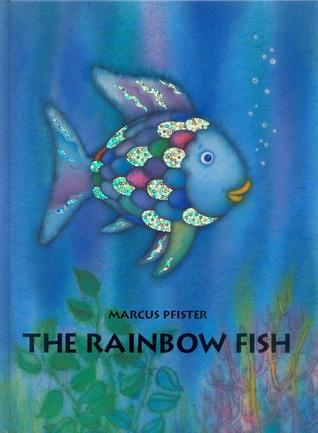
Review of The Rainbow Fish – Christian Literature
There are a lot of things about Christian media that frustrate me. I say that as a lifelong member of the church, though I have bounced many a time from from denominations until I found the one that clicked with me. It’s no surprise, now that I reflect on it, that the same words I use to describe what I disliked about so many churches I went to are the same I would use to describe my frustration with Christian media: cliched, hackneyed, oversimplified, and – for the worst of them – money grabbing.
I’m probably opening a bit strong here, but it is honest and probably important to understand before I discuss The Rainbow Fish by Marcus Pfister. Better you know that I know I’m biased before getting into it. I will do my best to consider this book for the appropriate audience, bias aside!
Analysis
The plot of this book is simple enough; a super shiny fish is overly proud of his super shiny scales and people dislike him for not sharing. He learns to share, and thus he finally makes friends. There’s not a whole lot to say there on the surface level, but it is worth noting that each page has a comfortable paragraph of text to read. I genuinely appreciate that the word choice and sentence structure are more complex; not only does it hopefully challenge the young audience to learn new words, it adds a lyrical sense of storytelling that makes this book a cut above some of its overly simplistic counterparts. The vocabulary, too, adds some complexity, using words like “whizzed”, “glimmering”, and “peculiar”. It’s clear that the writing is thoughtfully put together.
Still, the great delivery of the moral is nothing new. It’s really just a conglomerate of several gospel teachings: wealth does not lead to happiness, sharing wealth brings true satisfaction, and pride is a pitfall. I’m tempted to be put off by this and say “so what? A child attending church would hear these stories every week!” but that may not be true; this story takes those morals and puts them in a different light, and it’s never overtly Christian in nature. That makes the story more accessible, and might even trick some of those early readers who can’t focus in church to pick up on the lessons. So, for the intended audience, this book is really very successful.
The art is, by and large, very good! There’s a tone of details in the sea life that makes them feel very tangible and real, and of course the shiny scales add a texture that makes the book pop. My only big complaint here is that the faces of the fish are so frustratingly static. They don’t display a wide range of emotions even though the words cue it in. Even when the fish is supposed to be sad and frustrated, he looks like he has a small smile still. I can’t help but feel this is a failure for visual literacy; we need to see the emotions that are being described accurately represented.
Response
So now I will address my bias in full. Despite all my frustrations with Christian media at large, I don’t hate this book. In fact – and I’ve doubled back to write this sentence – there’s a lot that I actually rather like about it. It’s accessible to a broader audience and presents the problem to be a personal problem that requires personal responsibility to solve – something a lot of other media overlooks. Even using the wise octopus as a godlike figure, it’s accurate to what a real Christian experience would be: You are provided the tools through words of wisdom, but it is up to you to turn them into actions. Yes, it still oversimplifies some of the complexities of pride and forgiveness, but this is for kids, and overall, it’s a quite mature look at it.
Conclusion
My own bias going into this made me dubious as to the quality of this book, but I gave it a chance and some time, and I was wrong. It’s good – not perfect, but good. It is a little bit cliched, but it handles those familiar tropes with a maturity of writing and thought that makes the book a worthwhile read for any audience, Christian or not. 7/10
References
Pfister, Marcus. (1992). The Rainbow Fish. New York, NY: North-South Books.
Pfister, M. (1992). Cover Art for The Rainbow Fish. (Jacket Illustration). Retrieved from https://www.goodreads.com/book/show/766020.The_Rainbow_Fish?from_search=true

Review of Strange the Dreamer – Printz Award
Stories about stories are quite possibly the most difficult kind of story to tell. Not for want of trying – I’d say quite a few authors dabble in talking about the things that matter most to them by attempting to capture their own feelings about stories. The two pitfalls are obvious; either the side stories are so scant that they have little bearing on the bigger story, or so bloated that they begin to drown the main line out.
Strange the Dreamer is by Laini Taylor is a story about stories, and, spoiler alert, it dodges both pitfalls for the most part. It’s not flawless – but it is, through and through, a magical read.
Analysis
Strange the Dreamer is a 500 page book – quite hefty for YA – but it could have easily been a thousand, and I would have kept turning the pages. It’s a richly imagined, vibrant world that feels ridiculously tangible for something that is so deeply high fantasy. I attribute this in large part to Taylor’s rich language. She has a gift for taking simple, mundane things like the sound of a voice and spinning it together with a consistent metaphor that is both beautiful but telling. The phrase “a voice like wood-smoke” comes to mind, and while on one hand it makes no literal sense, it conjures up so much feeling; the coziness of a campfire, the comfort of cooking, the richness of a fall evening. Taylor does this again and again, making it impossible not to be sucked in by the dancing, playful language. It colors all of the plot with the precise imagination that makes you not just see the story, but feel it too.
That bleeds into the characters, too. There are no surprises, I think, with the characters – they fit pretty comfortably into fantasy tropes. Witches with their conflicts in power, people who have been broken by trial in days gone, bullies and victims, nerds and heroes. Yet the language with which we view them casts them in a new and genuine light. Stereotypes they may be, but they are not pieces on display in a museum; they are very much alive. And because of that, Taylor is able to create a romance in this fantasy book that is much more enticing than some dedicated romance books are. It’s so easy to root for Lazlo with his almost flawless dedication, and Sarai’s shift from distrust to intrigue to attachment feels all too real; just as much as the darker, frayed relationship between the “Godslayer” Eril-Fane and his wife’s relationship is shattered by trauma. These are honest and engaging characters, taking no shortcuts because of the genre.
Again, though, it isn’t flawless. There are many doors left open and windows left cracked because of how the stories are spread so thin here. Blessedly, the main characters in this one overlap a comfortable amount to keep the story momentum going, but with the number of threads Taylor sets out, not every one gets its fair due. There are twelve accessory characters brought along on this journey, and of them, only two get any sense of development at all, and only one of those two feels worthwhile to the plot. It’s also evident that Taylor has an immensely detailed backstory for this world that doesn’t seem to get enough attention, considering it’s utterly enrapturing when we do get to see it. And, there is a certain steamy sideplot that seems to have absolutely no consequence on the plot at large, which is my only full-on complaint about the book.
Almost everything we see is really great, but just feels unfinished. It is clearly set up as the beginning of a series, which is fine, but the conclusion of this novel feels to have closed the door to some of the best parts of it. Lazlo’s change goes from a comfortable, satisfying growth, to a sudden launch, which to me feels a bit like cheating us out of the rest of the excitement of discovery.
Response
Despite my complaints, I couldn’t stop thinking about this book once I started it. The poetry in the language slowed my reading of it down in all the right ways; I wanted to linger on pages, to consider the metaphors, to stop and imagine the situations. There’s so much of the book that seems like it should make me cringe from the familiar tropes, but it’s honestly just so well done that I ate up every word. I think the only solution to my complaints with this novel would have been to double its page count, which, unfortunately, is unreasonable for a book marketing to young adults. As is, Taylor no doubt had to make cuts and sacrifices to get it to the page count and to make sure the sequel was enticing. So, I’ve decided that this book is a strangely perfect transition book – something to take readers from YA to fully-fledged fantasy.
Conclusion
Books like this are difficult to do well, and even harder with the constraints and expectations of YA. Laini Taylor does a magnificent job leveraging a gift for language to spin one of the most compelling fantasy stories of late. It may be spread too thin at times, but while reading, it’s a whirlwind of delights. 8.5/10
References
Taylor, Laini. (2017). Strange the Dreamer. New York, NY: Little, Brown Books.
(2017). Cover Art for Strange the Dreamer. (Jacket Illustration). Retrieved from https://www.goodreads.com/book/show/28449207-strange-the-dreamer?ac=1&from_search=true

Review of Aristotle and Dante Discover the Secrets of the Universe – LGBT+
The difference between 2012 (the time of publication for this book) and 2019 (the year in which I read and wrote a review for this book) feels like much more than 7 years when you begin to consider how we approach topics that have been in the spotlight that entire time. Aristotle and Dante Discover the Secrets of the Universe by Benjamin Alire Sáenz, in telling the story of two gay teens in the 80s, takes on one of the most focal talking points of the decade.
As always, it is worth noting before I review: because of my life experiences, my ability to adequately comment on an author’s portrayal of gay, Mexican-American teens in the 80s is limited. I will try, as always, to focus my critique on where I feel most fit to comment.
Analysis
The overall plot of this book is certainly its greatest strength. The intrigue of it, despite being centrally about everyday things, keeps the narrative spirit alive. It is at once a coming-of-age story, a family identity story, and a romance. The blend of these elements are bound up inside the protagonist, Ari, whose depression is formed by his inability to reconcile his “shoulds” with his “ares” and his “knows” and his “don’t knows”. But it’s not just Ari who has to learn; in a remarkably touching way, he discovers how adults are people too, and they may not understand his exact pain, but they have plenty of pain on their own. That pain, Saenz seems to say, can drive people apart, but it can also be something that draws them closer together if they can share the load with someone else.
Still, the delivery of that plot was frustrating at times. It seems to me that nearly half of this book lends little to know bearing on the book as a whole. It is exploratory, which can be an amazing and engaging experience to read, yet it doesn’t quite use that exploration to demonstrate consistent growth. Instead, Ari seems to spike up and down, changing only with sudden revelations rather than growing awareness – it’s the difference between making spaghetti sauce for hours, gently seasoning and stirring, building up to an amazingly unique meal, and popping that Lean Cuisine spaghetti in the microwave for three and a half minutes when it’s convenient. Part of the reason for this is that although Ari is our narrator, his thoughts are far too secret even for us. There’s no depth to his thoughts – at times, it’s downright unreliable narration. Perhaps this is meant to keep us wondering, which I can accept, but I do believe that unreliable narration can have more detail and richness. The denial of one’s true identity can take a lot of willpower, a lot of questioning, a lot of thinking. But mostly, we see Ari doing things, even though he tells us this story.
And all of that is related to the written style. So much of this book is written in these short, curt, simple sentences. I became painfully aware at one point of a series of five sentences opening with “He” – he did this, he did that, he said this, he thought that. Perhaps this was meant to make us believe more that an actual teenager was telling us this story, but I’ve been teaching 15 and 16 year olds for several years now – they aren’t always so simple with their talking. In fact, I would contest that the simplicity and clarity of this writing is quite the antithesis of what an actual 16 year old thinks like. They are complicated in the most frustrating and most marvelous ways, and they can’t always express themselves like this. Ari is always, always, always so simple and straightforward, and Dante is always intuitive and thoughtful and reads really hard books. The spirit of this novel is pure and well-intentioned, but it’s not believable, not to me, anyway.
Response
But maybe believability isn’t the point. I try to think what the world was like just 7 years ago, and gay teens would have been facing a much, much harder time even then – not to say that it’s easy today. This book could very well have been extremely important to a lot of kids wrestling with that same point. And so I’m conflicted.
On one hand, I feel that the language of the book is stilted and stiff, and I don’t think the characters are a realistic representation.
On the other, I can imagine that this book was and maybe is very important to a lot of LGBT+ readers, by giving them a story with happy endings to dream about.
And I cannot say that a book written in 2012 is less important now that the world looks even a little different than before – To Kill A Mockingbird is no less important even if racism has changed its face. So I struggle to feel like I am evaluating this book fairly.
Conclusion
The central themes and overall story of this book are beautiful and well done. I struggle with accepting the language and buying into the characters, but I see value in the book as a whole. I cannot say I think it is the best book on the topic to read, but I cannot say it has no value. I am too conflicted at this time to provide a specific score – so I encourage you to read it and find out for yourself.
References
Saaenz, Benjamin. (2012). Aristotle and Dante Discover the Secrets of the Universe. New York, NY: Simon & Schuster.
Brabant, Mark. (2012). Cover Art for Aristotle and Dante Discover the Secrets of the Universe. (Jacket Illustration). Retrieved from https://www.goodreads.com/book/show/12000020-aristotle-and-dante-discover-the-secrets-of-the-universe?from_search=true

Review of Brown Girl Dreaming – Coretta Scott King Award
Somewhere, someone out there has the job of labeling books “children’s”, “young adult” or “adult”, and there are some book that make me wonder how that person ever gets any work done. Brown Girl Dreaming by Jacqueline Woodson is the prime example; her book is moving, unsettling, heartwarming, and heartbreaking, and there’s nothing in particular about it that screams “this is for children”.
Analysis
Autobiography is a notoriously difficult genre for children to get into. The stuffiness of history books can often feel suffocating compared to the grand, sweeping adventures fiction provides. Woodson, however, does something remarkable; she makes you forget that this is an autobiography. The lilting, emotional story made me stop and double check a few times to make sure I had it right. Sometimes, in the way she spins her story, it’s easy to forget that she’s telling her story. All true stories are told with some liberties, but Woodson genuinely finds the magic of childhood in her writing. The stark differences between Ohio and Virginia and New York give the author many tools to work with, but she especially excels at capturing the warm, southern beauty of Virginia. It is here where the most magic happens, in her grandfather’s garden, and the picturesque retelling feels almost unbelievable.
But perhaps that’s why this book is so wonderful; it’s not that it’s a one hundred percent perfect reproduction of all those places and memories and people, but that it’s an artistic rendering of a childhood memory. The book as a whole seems to be seeped in a mixture of nostalgic happiness and bittersweet love and, interestingly, an almost somber tone. As she recounts the many deaths she experienced while growing up, it is impossible to avoid sadness, of course; but the interesting part of the happy memories, is that Woodson strings together details that are letting us know that she knows where it’s going. Her grandfather’s cough, her uncle’s many promises, and her father’s forlorn nature all are “hindsight’s twenty-twenty” as an adult author retelling her childhood – as a child, she would never have taken note of these things in advance. Furthermore, it’s clear she takes liberties with those earliest memories. This doesn’t invalidate the authenticity, but it is important to note that there must be artistic license with how she remembers these different moments.
Where Woodson takes this from a decent book in verse to an excellent one is with her understanding that using poetic structure allows you to emphasize words, and, crucially, she understands that you can create a really impactful moment by highlighting words other than nouns and verbs. There are so many times she has a single “which” or “because” standing alone in a phrase, which adds a flair and signifies transition in delightful ways. Still, she does not go overboard with symbol or imagery – at its heart, this is storytelling, plain and simple.
Response
Having read a handful of Civil Rights-era novels wherein the main characters are steeped in the midst of the conflict, I couldn’t help but love seeing what it might really be like for a child to be growing up in that time. At her age, Woodson would not have been so actively involved in the movement – though it does end with her older and more active – so we get a fresh point of view. It was impossible not to hear about what was happening or to see it. There were people, even those who supported the movement, who were reluctant to press the issue in the face of adversity. There were kids just being kids while all this was happening. It’s a backdrop to the true story, and I think that probably is true to form for a lot of people’s experiences at the time.
Conclusion
Brown Girl Dreaming is a richly spun autobiography with a lot of smart language choices and a fresh perspective on a historical experience. It’s somber and reflective, and thoroughly gripping. It is a must for anyone who is interested in this time period. 9/10
References
Woodson, Jacqueline. (2014). Brown Girl Dreaming. New York, NY: Puffin Books.
Puffin Books. (2014). Cover Art for Brown Girl Dreaming. (Jacket Illustration). Retrieved from https://www.goodreads.com/book/show/20821284-brown-girl-dreaming?from_search=true

Review of The Westing Game – Mystery
I have to be honest. I did not pick this book after lots of research; I did not pick it because I knew anything about it at all. I picked this book for one simple reason: my wife had bought it, it was sitting on the shelf, and I needed a mystery book to read.
It is incredibly fortunate that Ellen Raskin’s The Westing Game is a wildly fun book that is equal parts hilarious, charming, and intriguing from the first page.
Review
This book hinges on its incredible cast of characters. There is some magical quality to the characters here that makes you feel like you’ve known them forever, yet they aren’t quite stereotypes. Somehow, Raskin has crafted people who, from the first sentence, you know everything you need to know to understand them, yet you don’t know all the secrets they’ve tucked away. And then, brilliantly, Raskin has paired them off into their most interesting combinations – good-natured and gossipy Sandy with the smart but harsh Judge J. J. Ford who do the most direct legwork, all the way to Jake and Madame Choo who don’t even play the game. Even as their secrets are uncovered, you never feel betrayed by the author or like the rug has been pulled from under you; instead, you learn their secret, and you understand them a little bit better.
The mystery itself, interestingly enough, often feels like a backdrop for the more convoluted interpretations and reactions from the characters. It does, of course, keep you wondering – that’s the point of a mystery, no? – but it works more like a thread pulling characters together than anything else. The clues seem only to develop as the characters reveal something about themselves or each other, rather than random strokes of brilliance, but that’s what makes this book shine. It’s not actually the story of twelve people trying to get rich quick; it’s the story of twelve people who have honest stories and difficult problems learning to overcome them. Sure, the mysterious Sam Westing is Oz behind the curtain, pulling the strings in a Deus-ex-Machina sort of way, but once the story is set in motion, it is for love of the characters that you keep reading.
I think my largest complaint by a mile with this book is the conclusion. There is, as it seems to me, a natural built conclusion, then an epilogue. The epilogue spins out the remaining story of all twelve heirs over the next thirty years or so. It’s not bad necessarily, but the conclusion of the mystery has such a neat and powerful close that the tag ending feels like a last minute addition that cuts the tension. It is emotional, but almost overly so in a way that didn’t match the tone of the rest of the book. In other words, the book ends with a bang, but then smoke lingers for a few minutes while you cough and fan it away.
Response
Mystery has never been my genre. I honestly cannot think of another mystery novel that I have read from beginning to end besides this one, because every other one I’ve started has always lost me too quickly. The characters are too stiff, the intrigue isn’t intriguing, or the conflict is just too mellow. I really did not expect to like this book – hence the “I’m reading this because it’s within arm’s reach” approach. Imagine my surprise when I found myself adoring this book and recommending it to three people immediately. But like I was mentioning before, it was less about having to know what the solution to the mystery was (I was content letting the author tell me the solution) and more about having to know who these characters were and what they were hiding. The masterstroke of this mystery is that you’re told the real mystery before the Westing House is mentioned at all – you’re given a description of the characters’ secrets, and you have to learn which one is which. Who’s the bomber? Who’s the mistake – and what does that mean? It’s perfect for me.
Conclusion
Raskin’s The Westing Game has a ton of staying power – it’ s been around for four decades and still the title is tossed around from time to time. But this book deserves every mention it gets. It’s enticing and the characters will capture your heart and crack you up on every page. The only part of the book that drags is the ending, but some people may find it more comforting than I did. This is a classic that deserves the title, and it’s won me over on giving the genre another chance. 9/10
References
Raskin, E. (1978). The Westing Game. New York, NY: Penguin Group.
Raskin, E. (1978). Cover Art for The Westing Game. (Jacket Illustration). Retrieved from https://www.goodreads.com/book/show/902.The_Westing_Game?from_search=true

Review of The Only Road – Pura Belpre Honor Book
Writing books that are closely attached to current trends can be a big risk. For books that are attached to a popular trend (say, vampires), it’s easy to get buried, washed out, and have no staying power. For books that are attached to social and political trends, well, you can lose buyers because of the difficult themes, misrepresent the issues, or lose relevance in a year or two.
The Only Road by Alexandra Diaz is, I think, a book that transcends those challenges. Certainly still relevant three years after its publication, Angela and Jaime’s harrowing journey is rife with tension and high emotion, never letting up until the last page.
Analysis
This entire book is beset by emotions from the first page – opening with a shrill scream. It ranges in depth, masterfully, from crippling sadness to gripping fear to small but strong hope. Diaz accomplishes this primarily through turning these emotions into a physical description of Jaime’s experience. Whichever emotion he is feeling, Diaz often includes an accompanying physical feeling that helps the reader more closely share his experience. Even if you have never felt the claustrophobia of a cramped train car or the accompanying fear of the darkness, you have likely felt something that gnaws at your stomach or felt heat that’s so oppressive you just want to leave. But what makes these scenes work so well is that we are constantly reminded that Jaime cannot resolve these emotions as easily; there is no escape for him until his journey is over. His experience is a stark contrast to what most readers would know, but it never feels emotionally inaccessible.
The social relevance of the book, because of those emotional moments, is profound. The author deliberately explains in painstaking detail that Jaime and Angela are just children, and more importantly, they are aware of all the risks they are taking, and even more importantly: they don’t really want to be on this journey. Diaz even points out how the U.S. is unfriendly to immigrants (citing at one point the concentration camps three years before they became headline news), yet they had to go anyway. It is a challenge to readers who don’t know different, to those who have limited knowledge of the actual experience. This book had to be about children in order for this to work, because Diaz wants to ask the American readers: How could you not root for them? How could you turn them away? And it works, devastatingly, because if you’re reading this book, you can’t turn them down and you can’t help but feel pained whenever others’ whose path they cross ends in tragedy or tails off into mystery. In a decade, this book will either be considered historical fiction or will still be a hallmark book detailing the why of illegal immigration.
Perhaps what’s most surprising about this book is on the inside cover: “For ages 8-12”. This book is unflinchingly and sometimes brutally honest; it does not shy away from the harsh truths that come with the journey. We see violence from law enforcement and from criminals, we see a dog torn open and sewn back together, we see the insufferable, filthy conditions that our protagonists must put up with, and never once does it feel like Diaz is filtering what she says. This honesty is unavoidable for a book on this topic; to write it any other way would be a disservice. But for as difficult as it can be, it’s refreshing to see that honesty for a children’s book. It opens a lot of doors for genuine understanding of what this situation really looks like, which kids may not have any other way. And there is no better time to learn empathy for others than in one’s youth.
Response
Yes, I am biased here. Three years later and with the media limelight, the issues with immigrating to the United States look worse than ever, and I already feel sympathy for those who are trying to escape their pasts. But what this book did for me that I did not have before is insight into what that journey might really look like, especially for children. Their parents are gambling because they know their fate if they stay is one doomed to either become violent or die to it – or both. But that “maybe” of sending them thousands of miles away is powerful. Crucially, Diaz shows a lot of answers to the “why” questions people might ask.
Why don’t they just come legally? The legal process is too slow, and gang violence might claim them first.
Why don’t they just stop the gang violence? That’s out of the hands of the everyday person, and most of the law enforcement is corrupt too.
Why do they think that we’ll accept them? They don’t, not at all.
What kind of parent sends their child away like that? One that must.
I would put this book into the hands of any doubter. The problem is that I doubt many of them would give it a chance – and even from those that did, I imagine many would discredit it as fiction. It’s problematic, but that does not take away the value of Diaz’s work. Hopefully, one day, it’s used to say “look how bad things used to be; let’s not repeat that.”
Conlcusion
The Only Road is unflinchingly honest and powerfully motivated, two factors that allow a gifted author to create a remarkable book. The book’s crowning achievement is in its emotional drive, allowing audiences the kind of empathetic insight required for a hard topic. It’s a book that belongs in the hands of as many readers as possible. 9/10
References
Diaz, A. (2018). The Only Road. New York, NY: Simon & Schuster.
(2018). Cover Art for The Only Road. (Jacket Illustration). Retrieved from https://www.goodreads.com/book/show/25226174-the-only-road?from_search=true
Review of I Know Why the Caged Bird Sings – Nonfiction

Maya Angelou’s gift for language should easily be considered among the greatest in history. There are times when it is dauntlessly over-the-top and times when it is quietly critical, spanning from the proudest human achievements to their deepest worries and fears. Her decision to take that gift and apply to her own life and true experiences helped redefined the biographical experience, beginning of course with I Know Why the Caged Bird Sings.
Analysis
Angelou’s autobiography is sometimes the target of critique for its application of literary techniques, but those same techniques are what makes this book so special and so readable. A focus on theme should not be considered a detriment to a true story; after all, literary themes are meant to reflect true human experience. So when she explores her own life with the richness of fiction, she amplifies what she finds important. Moments that would otherwise slip past the audience are made unique, special. The naming and renaming of each store in a transition helps us to understand the impact of the population change, even though a simple statement would officially suffice for it. The horrors and trauma that she experiences and witnesses are delivered with emotional gravitas that the traditional biography would not allow for; so too do her triumphs and pride. In my mind, the aforementioned criticism is absurd, because in reading this, I am convinced that it is not artistic liberty that Angelou has taken – it’s simply how she remembers these moments and how she can best communicate the way it feels.
Because of that, the people that Angelou chooses to talk about are brimming with life. It is of course unlikely that she can remember the words that were said as verbatim as she writes them down, but there’s never a time where the dialogue feels unbelievable or overly fictionalized. The conversation between Angelou’s mother and Sister Flowers comes to mine, where they discuss the work they do, their faith, and Angelou caught in the middle feels very much like a real interaction. The adults talk as they do almost as if the child isn’t in the room, and their actions seem to steamroll the child’s feelings. The feeling of the outsider looking in is palpable, and Angelou is simply caught in the middle. The author’s gift here is that she combines the feeling of the memory, which is certain to be the most true portion of her memory, with as honest of a dialogue as she could reproduce. Especially in moments of shame, how can we remember the words that were said, so much as the burning in our cheeks and our stomachs dropping to our pits? So, yes, the characters have a little bit of fiction to them, but never in away that challenges the authenticity of the experience.
There is so much value crammed into this book of one person’s experiences because of the vast topics Angelou covers as she recounts her experience. It is equal parts historical – tracing the changes in society as she saw them happening – and personal, as it explores the many changes a person has based on various experiences. In this, the book appeals to the fan of history, but also reaches people who have had similar experiences, or even those who have watched loved ones go through these things and want to know what might be happening in their mind. It’s a spectacle of humanity, on large and small scales, and it makes every word count.
Response
I had read the fifth chapter of this as a reading for, I think, two different classes. I remember the strangeness and confusion of witnessing, through Angelou’s eyes, her family’s mistreatment and unfaltering resolution. I realize now that it’s a deep shame that in the entirety of this book, I was only ever exposed to a single chapter. On top of that, I never had it explained that this whole autobiographical book is a challenge to the idea of a biography at all. Perhaps if I had learned about the art of biographical writing, I would have taken to reading more of them, or at least looking for more like this one. Cover to cover and in every chapter, this book is simply meaningful. There is so much to explore, so much to unpack, so much to ask. It is, now, making me reconsider my reading habits. It may be time to stop dismissing nonfiction biographies out of hand so quickly, and taking time to seek out stories of people who interest me that are written in an interesting way.
Conclusion
Angelou’s work is unforgettable. It turns the biography genre on its head by thinking about how a story can be at once true, interesting to read, and meaningful on a social, emotional, and personal level. It has the storyteller’s edge for adding detail and richness of dialogue that hint at fiction, but it never becomes unbelievable. Through and through, this is a book that should find its way into everyone’s hands and hearts. 10/10
References
Angelou, Maya. (1969). I Know Why the Caged Bird Sings. New York, NY: Random House.
Halverson, Janet. (2002). Cover Art for Damsel. (Jacket Illustration). Retrieved from https://www.goodreads.com/book/show/13214.I_Know_Why_the_Caged_Bird_Sings?from_search=true

Review of Damsel – Printz Honor Book 2019
Fantasy and fairy tales have always enticed author and audience alike because, I think, it can be as multifaceted as you want it to be. We have our classic fairy tale stories at the center, but you can nudge, poke, prod, twist, and flip and you find something new and exciting to work with, and for the best of them, you find something wholly unique. Elana K. Arnold’s Damsel, though not without noteworthy problems, is among the best in recent years.
Analysis
Arnold’s clever leveraging of mystery and fantasy helps keep the momentum of this novel moving forward. Oftentimes, a prologue in a book can give you something that’s irrelevant for hundreds (or for adult fantasy series, thousands) of pages, or be something utterly forgettable. Here, instead, we are given the overblown fantasy prince who is doing battle with a dragon, presumable failing, and then, suddenly, we skip to the next scene. The mystery of it isn’t entirely obtuse – it doesn’t take long to deduce what’s really happening. But it does build into the plot a nice approach to fantasy storytelling that’s often overlooked. Instead of dwelling on the battles and the politics (though there are plenty to work with), we are treated to a character study in a fantastic setting. It’s a smart way to keep the book feeling fresh and taking a new approach to discussing the issue.
As I said in the intro, there are a handful of noteworthy problems. At times, the oppressive sexism leading to self-discovery and empowerment feels dated; a lot of books have explored these topics before, and while it will always be important to tackle, this book’s modern audience would have a much more nuanced experience with it. Not many readers would suffer under such blunt “I am a man and therefore you must listen”, and so there’s less for them to draw from it. The ending of the book, too, feels tragically rushed, while the middle stalled on some parts that seemed not to come back around to anything. The conclusion has several gratuitous events that shattered both the pacing and the tone of the book leading up to it, and frankly it was a bit like walking a massive and opulently detailed rug that suddenly turned into 80s shag carpet.
Still, in that stalled middle, there’s a lot of rich and disturbing content that challenges a lot of the pre-existing fantasy tropes, and, even more importantly, challenges the Good Guy characterization. This, unlike the moments of overly simplified sexism, is extremely relevant. Emory’s entitlement not just to the throne and to praise, but to obedience and sex so smartly reflects a modern issue. There are so many women who have experienced the guy who puts on a show of being kind and helpful but for transactional reasons – Reddit has an entire site dedicated to exposing this kind of malignant behavior. That makes this book extremely valuable for the modern young reader, as many young women may not be aware of that manipulative behavior, nor how to see through it for what it is. Other parts of the middle flesh out many characters in an interesting way, particularly Pawlin who seems to understand much more than he lets on and keeps the intrigue of the mystery alive through his sideways comments and wry smiles.
Response
I’ve mentioned before that I read a lot of fantasy, and I do. I also love fairy tales turned on their head. So, naturally, Damsel was interesting to me, and I do think it’s among the better ones as of late. That said, I also think there’s been a slump in the genre as of late. The flaws in this book are sometimes grating, and the deftness of the mystery could likely be executed much more effectively. Hopefully, the successes of this book inspire others to explore similar topics but with a higher degree of success. As is, this is good, but plot holes and, at times, a less-than-impressive style dry out some of the rich potential this book has.
Conclusion
Damsel is a strong inverted fantasy, with some extremely important topics for modern readers. It does suffer from hiccups in the pacing and overly simplified plot elements, but nonetheless it’s an enjoyable and frightening read in a successful way. 7.5/10
References
Elana, Arnold. (2018). Damsel. New York, NY: Balzer + Bray.
Vault49. (2018). Cover Art for Damsel. (Jacket Illustration). Retrieved from https://www.goodreads.com/book/show/36260155-damsel


 Collin's Reading Blog