Review of Fly Guy Meets Fly Girl – Easy Reader

One unfortunate reality of reading is that not every book is made for every person. It becomes more difficult to keep this in mind when you’re knee-deep in books made for 8 year olds when you’re 18 years older than them, but I still sometimes struggle with the question “Why this book?” or “Why not that book?” Fly Guy Meets Fly Girl by Tedd Arnold is certainly one of those books for me – I’ve heard about how much 3rd graders love the Fly Guy books, so I was excited to dig in, but… Well, it has its moments, but it certainly doesn’t “wow” me.

Evaluation

Let’s begin with the vocabulary. This aspect of the book really affected my enjoyment of it (probably one reason I don’t see eye-to-eye with eight year olds about it), primarily because the use of language just seems so stilted and unnatural compared to other books of this level. For a book about messy kids and their messier pets, I thought it was strange that the language had this feeling to it. For example, many pages use so actively avoid contractions that it seems to as if the author intentionally went out of their way to be formal, perhaps with the expectation that teachers would want kids to read something with proper grammar. Consider the following sentences: “Fly Guy and Fly Girl both said, ‘Wuzzle wuzzzup!’ That is fly talk for ‘Let’s be friends.'” (Arnold, p. 28, 2010). Several pages use this format of writing, but the concluding sentence has a very unnatural vibe to it for this age group; “That’s fly talk” or even “which is fly talk” both have a much more natural vibe to it. It also does not challenge the vocabulary of the reader like other books do – such as the Piggie & Elephant Series.

Where the vocabulary is weak, however, the artwork shines. Entire pages are dedicated to storytelling through images only, and the cartooning art style brings a unique and enduring charm to the series. Despite being a story about flies, the author and artist has turned the critters into adorable and hilarious caricatures not unlike the human characters as well. He brings emotion to the forefront, mostly through the eyes, which makes the characters much more believable than the words they say.

With the two elements combined, perhaps the greatest success of this book is in the refreshing and modern approach to a love story which leaves a pretty important message for young readers. Despite all the happy dreams and possibilities Fly Guy and Fly Girl share, they both realize that as pets, they are too meaningful to their owners to up and leave them behind. Instead, they decide to simply be friends. In today’s world, there are still these boundaries drawn between how boys and girls can interact, and friendship without romantic expectation is a difficult bridge to gap, but it’s increasingly important that we teach kids how to navigate that type of relationship.

Response

I cannot overstate enough how important I think it is the kids are exposed to friendship between different genders in a healthy and meaningful way. There are many times I can think back to my own elementary school years in which kids ridiculed boys and girls who tried to be just friends – even in upper grades and beyond, it seems like it can be difficult for some people to overcome that hurdle. It certainly could have delivered that message more effectively between the language and amount of time spent on the topic – whereas 6 pages are spent showing images of romantic dreams, there’s not actually a thorough depiction of the two flies being just friends. So I ultimately have mixed feelings – there are good ideas here, but there is clearly potential for this book to have been something more moving and powerful, without sacrificing the lighthearted nature of it all.

Conclusion

Fly Guy Meets Fly Girl is a lighthearted book that gets some things right. Despite an awkward written style and a peculiar use of time management, the author manages to pull off a sweet and meaningful story. I would recommend this book as a starting point for conversation, but consider looking elsewhere for more depth and meaning. 6.5/10

References

Arnold, Tedd. (2010). Fly Guy Meets Fly Girl (Fly Guy #8). New York, NY: Cartwheel Books.

Arnold, T. (2010). Cover Art for Fly Guy Meets Fly Girl (Jacket Illustration). Retrieved from https://www.amazon.com/Fly-Guy-Meets-Girl/dp/0545110297/ref=sr_1_1?hvadid=77653050038770&hvbmt=be&hvdev=c&hvqmt=e&keywords=fly+guy+meets+fly+girl&qid=1561414044&s=gateway&sr=8-1.

Review of Stef Soto, Taco Queen – Texas Bluebonnet Book

Debut novels are often delicate and messy things. They often fall into a couple of common pitfalls of writing, or underestimate the audience’s ability to figure things out, or sometimes, they shoehorn in a big moral lesson. Writing a book is hard, so it’s no wonder many authors’ first big book is deeply flawed. Jennifer Torres’s book Stef Soto, Taco Queen is not one of those debut novels.

Well… almost.

Evaluation

The crowning achievement in this novel is Torres’s effortless use of language and vocabulary, particularly in how she navigates using Spanish words in an otherwise English novel. She rarely explains verbatim the meaning of the word, and when she does, that explanation in and of itself is meaningful. In chapter 1, the protagonist Stef’s father says “órale”, which Stef explains has several different meanings (Torres, 2017, p. 4). Throughout the rest of the novel, when órale is used, the reader must use context to determine which meaning is implied. Many other Spanish words can be understood based on the dialogue or Stef’s narration. It seems like a small thing, but it speaks volumes about Torres’s ability to navigate language. Additionally, Torres does not shy away from varied grammar – at different points, she uses long, sprawling, descriptive sentences alongside short ones. She uses a series of semicolon phrases flawlessly; not many children’s books take that risk. Though the language and vocabulary are complex, they never feel out of place or, more importantly, out of reach.

The characters in this book are also characterized in really meaningful ways. Although many of them are flat and static to the point where they shouldn’t be particularly believable, Torres establishes those flat characteristics with action and detail over simple description. Most prominently, Papi is shown to be a kindhearted and good-natured man, though appropriately the protagonist never thinks nor states this. Instead, we as an audience can see who he is by her observations. He goes out of his way to meet dietary restrictions, he trades food with a neighboring truck instead of complaining about competition, and, crucially, when he speaks in defense of the food truck industry even though he believes his own business is doomed, he explains that he did it because the other people needed them to do it (Torres, p. 144, 2017). The central characters are almost always characterized as such, which makes them feel so much more realistic even when other aspects of them may not be – for example, Stef’s parents never once raise their voices or berate their daughter despite her frequent arguing and inconsideration. Still, you have to mull over the book for a few minutes before those less believable qualities come to mind thanks to some wonderful narration.

But it’s not just the characters who are brought to life – the world itself comes alive with Torres’s sharp attention to detail. At one point, Stef thinks about how her reflection looks fuzzy and warped on a stainless steel fridge; her friend Arthur attends Korean school on Sundays; the process, sight, and smell of cooking tacos is so specific you can taste it. Even the conglomerate of food trucks are singled out and given names – “Dim Sum and Then Some” being my personal favorite. All of these details don’t have to be in this story to move it forward, but they really do make it shine.

Response

This book is really meaningful in a lot of ways. The early comments that create resentment in Stef about the smell of tacos clinging to her reminded me of similar things I’ve heard from my Pakistani friend as well as my Indian students, who all expressed self-consciousness about the smell of spices from their family’s cooking. Even readers who don’t share the experience that closely should be able to recognize that every family has something particular about them that might make them self-conscious, which makes it all the more meaningful to see Stef embrace her father’s love in spite of the criticism she receives. Now, I would be remiss if I only heaped praises on this book – there are some areas where I feel Torres pulled her punches on the difficulties Stef faces, perhaps because of how many obstacles are included in 160 pages. Stef hurts both of her closest friends’ feelings, but all is immediately forgotten with a simple apology; as a seventh grader, she somehow manages to have enough paint to cover an entire truck; the conflict with the city council never feels truly threatening which weakens Stef’s big moment with them. That doesn’t cover all of the conflicts in the book, but it does allow me to point out that failure – true failure – is not addressed in this book. Stef always wins. It’s heartwarming, but it’s also where it becomes blatantly clear this is a debut novel. There are simply too many conflicts for all of them to be addressed in good depth, and that cuts back some of the grandeur of this book.

Conclusion

Stef Soto, Taco Queen is a highly successful debut novel from Jennifer Torres. Torres excels at building a vibrant world with vibrant characters, and she clearly has a gift for language. Still, there are so many threads of conflict that seem to get in the way of one another, leading many of them to be resolved in an unsatisfactory way. Nonetheless, this is a book that is full of heart and creates a real excitement for reading. It’s impossible not to wonder what Torres will do next. 8/10

References

Torres, Jennifer. (2017). Stef Soto, Taco Queen. New York, NY: Little Brown and Company.

Harriet, R. (2017). Cover Art for Stef Soto, Taco Queen.. (Jacket Illustration). Retrieved from https://www.goodreads.com/book/show/25150366-stef-soto-taco-queen?ac=1&from_search=true.

Review of Elephant & Piggie: I Really Like Slop! – Children’s Early Reader

Evaluation

Before we begin, I have to acknowledge that early reader books are well outside of my wheelhouse – in fact, before I began typing this sentence, I held this up to my wife and said “Wait, is this a book a kid would read on their own?” And, she was the one who said Mo Willems is great when I was looking for books to read (we have a stuffed Pigeon from his other series somewhere). That said, I am happy to say that there are a lot of really smart details that Mo Willems has tucked away into I Really Like Slop!.

The words and concepts are where Mo Willems shines, but I want to start with the art. It’s no secret that Willems uses a very recognizable and simple cartoon style. Sometimes, I find it to be too simple, but other times, it’s perfectly charming. In this book, it primarily serves the basic function of reinforcing what the characters are saying. Piggie is enamored with her meal, practically swooning, and her face says it all; similarly, Gerald’s discomfort and suspicion are plainly evident in every feature. On some pages the art becomes repetitive – we’ve seen it all already. However, it works really wonderfully when Gerald crosses a line and over a span of four pages we see his shift from anger and disgust to ashamed and apologetic. Still, I can’t help but feel the massive, blank, white backgrounds are wasted – Willems could certainly do more to treat our eyes to details that would pull the whole story together.

Of course, this story is entirely driven by dialogue – though this could easily have focused on simplifying the storytelling, I think there’s a lot happening behind the basic words that show us a lesson that isn’t simply handed to us. I had my doubts at first – the repeated, simple vocabulary doesn’t do any favors to making this book stand out. But Willems deftly adds a good layer of discussion through a simple line from Piggie – “Eating slop is part of pig culture” (2015, p. 14). This adds a lot more impact to Gerald’s moment of shame, as well as his subsequent effort to try the slop. It’s so simple, but it takes it from a story that just tries to be funny (looking at you, Dragons Love Tacos) to a funny story that also explains how to respond to cultural differences.

Although much of the language is overly simple and, perhaps, could be a little less repetitive, what really makes this story work though is that Willems is honest about Gerald’s response. There is something about his honesty in saying “I do not really like slop. But, I am glad I tried it.” that makes even this cartoon elephant more believable than some human characters in other stories (Willems, 2015, p. 52-53). Willems again has added a touch of truth to how culturally exchanges may go, explaining that there is value in the experience of trying these things even if you do not enjoy it. It’s a wonderful way to treat newly independent readers to the opportunity to learn about something very real and relevant to their lives.

Response

This book totally surprised me. Again, a lot of that is probably due to my lack of experience, but in the early pages I was expecting this to be a book published to make a quick buck – and maybe it was, but the message is still refreshing and avoids being didactic quite nicely. Especially in the modern era, children are more frequently exposed to new cultures, and it can often be difficult to know how to respond – and even more difficult to know that it’s okay to not share someone’s love for something from that culture.

Conclusion

I Really Like Slop! may not be the next great artistic achievement in children’s literature, but it certainly is a refreshing and meaningful read. Despite a simple and easy art style, Willems navigates a modern problem kids may face with a charming honesty and realistic approach. I’m not familiar with other books from the series, but this book is the 24th in the series, and I can’t help but think that Willems has found an excellent method for challenging young readers with appropriate topics. 7/10

References

Willems, Mo. (2015). I Really Like Slop! (Elephant & Piggie #24). New York, NY: Hyperion Books for Children.

Willems, M. (2015). Cover Art for I Really Like Slop!. (Jacket Illustration). Retrieved from https://www.goodreads.com/book/show/25067039-i-really-like-slop?from_search=true.

Review of “Grandpa’s Hal-la-loo-ya Hambone!” – Texas Bluebonnet Award

Evaluation

While scouring my local library’s shelves for fresh books to read, I pulled a book off the Bluebonnet shelf at random – Grandpa’s Hal-la-loo-ya Hambone! by Joe Hayes and illustrated by Antonio Castro L.. I was initially put off, because the realistic style on the front and the over-the-top style. As soon as she saw it, my wife said her third grade students loved this book – and those third graders really know their stuff. What’s not to love here?

Hayes’s folkloric style leads to a story of marvelous simplicity that draws you into this dusty, dry world our protagonists inhabit. By the time he gets to the tall-tale event of the autonomous dentures, we’re so comfortable in the story and he understates the event so matter-of-fact-ly that we just accept that this is part of their life. In fact, much of the book states things as-is. The characters never complain about their poverty, even if their faces show it, and the author never plays up why the addition of a hambone is so significant. This leaves a lot of room for the reader to do some of the thinking. Is grandpa really that impressed with hambone beans, or does he just do that to make the work the dad has put in worth it? Why don’t they complain about their poverty? The authors have given the readers room to dwell on the story, which fits in perfectly with the folkloric style.

The longevity of this book is cemented by the artwork, which so delightfully adds extra details that may not be directly attached to the story, but certainly help us to understand the characters and their home a little better. As early as the second page, you see long, barren rows behind the vibrant beanstalks – the only plants that grow here. Those empty rows make it look like someone tried to grow something else and further reinforce the sense that the town was poor and wanting. More than anything, it’s the facial expressions that tell us about the characters – Grandpa’s far-off stare as he dreams of other food, the mother’s grimace as she first sees the hambone showing her concern, the gossiping neighbors snickering as the mother strings the bone up. None of these examples are explicitly mentioned in the text, yet they seem to pair so well with the words to develop the author’s vision. Even the details in the setting help to bring this world to life. When they are outdoors, the world is equal parts dry and expansive. The background colors range from a sullen brown when grandpa is glum about the meal, to vibrant blues that reflect the characters’ good days.

There is just so much story packed into the scenes, well beyond what the words on the page tell you. It’s like getting two books for the price of one.

Response

Before you think I am just singing the praises of a book I know has already received acclaim, I have to remind you that I was initially disinterested in this book. It doesn’t match my interests in any way – I usually prefer reading books from this age group to be bolder and brighter with their settings and stories – but I found each page was astonishingly delightful. I think it’s wonderful to share the stories of impoverished people who face things with dauntless optimism, as some kids come from families like that. Though not impoverished, I couldn’t help but think of my own grandfather, a World War II POW and Veteran, who always found joy in the little things and tried to share it with others. I imagine many people will have someone in their life, family or otherwise, who reminds them of Grandpa in this book.

Conclusion

Despite my initial misgivings and bias, this book is a heartwarming success. Hayes’s writing spins a charming folktale that feels like it belongs around any campfire, and Castro’s illustrations support that while still telling a story of their own. New tall tales may have a hard time reaching new audiences, but this is a book that breathes life into its pages, and readers of all ages are sure to find delight between the covers if given the chance. 10/10

References

Hayes, Joe and Castro L., Antonio. (2016). Grandpa’s Hal-la-loo-ya Hambone!. El Paso, TX: Cinco Puntos Press.

Castro L., A. [2016]. Cover Art for Hal-la-loo-ya Hambone!. [Jacket Illustration]. Retrieved from https://www.goodreads.com/book/show/31244611-grandpa-s-ha-la-loo-ya-hambone.

Review of Dragons Love Tacos – Children’s Picture Book

Evaluation

Every so often, we read books that we want to love, maybe even should love, but we simply don’t. Dragons Love Tacos by Adam Rubin with illustrations by Daniel Salmieri is one of those books for me. The premise should be right up my alley – I love dragons, I love tacos, so why don’t I love Dragons Love Tacos?

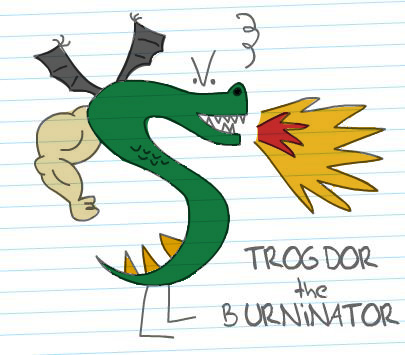
Let’s begin with the illustrations. There is a certain charm to the artwork, but the longer I dwell on a page, the more I felt the illustrations failed to create much depth with their detail. The dragons are initially fun to look at, but as you go along, you begin to see the repetition in shape, size, and pose, and the design of each dragon at times feels oversimplified, as sometimes the texture of the scales is simply left out. I can’t help but be reminded of the “How to Draw a Dragon” video that spawned the internet’s favorite dragon, Trogdor – first draw an S, then draw a slightly bigger S. Additionally, the sheer quantity of tacos drawn for each page is sometimes humorous, but again do little to draw the eye as they all begin to blend in to one another. Suffice to say, the detail on each page left me wanting due to repetitive techniques.

It’s also worth noting that the composition on the busy pages does little to direct the viewers’ eye. There is so much to take in on each page, which can sometimes be wonderful, but several cases here I usually find it difficult to pick out what is important. For example, the page that declares “these dragons love your taco party”, the protagonist boy is tucked into the back left corner of the two page scene, dwarfed in size by everything else that is happening (Rubin & Salmieri, 2012, p. 17). Although he is getting a grateful kiss from a dragon, which seems to support the text the best, it is difficult to see in an otherwise chaotic scene. The next page is well-composed – one dragon is passing off a jar of salsa to another. It’s right in the middle of the page, glowing in a splotch of yellow against a white background, as the protagonist looks on in horror from the background. It’s perfect! But, alas, the next page, devoid of words, repeats the picture of the salsa being passed, just zoomed in. The illustrations seem to downplay the understanding even a young child could have, and it damages the pace of the book.

On that note, the language of the writing itself does not always give credit to a child’s understanding, particularly through vocabulary. The standout moment of this is on page 13, when it reads “the only thing dragons love more than parties or tacos, is taco parties (taco parties are parties with lots of tacos)” (Rubin & Salmieri, 2012). It is so peculiar to include this side mention explaining, of all things, what a taco party is, especially since near the end, the author has enough faith to say “good Samaritans” without addendum. And at times, the repetition of ideas becomes tedious – the things dragons love and the things dragons hated are repeated on nearly every page, as though the readers may have forgotten. It’s easy to say that it could be done for rhythm or musicality a la Green Eggs and Ham, but this writing has neither of those qualities.

Response

And yet.

Even though there are all these elements that make me feel a little frustration, the things I feel I can pick apart, the word choice that makes me cringe, I can’t help but smile at the book. I doubt it will have the lasting impact that some children’s books have, but I’m also confident that there will be plenty of kids who remember this book with nostalgia. It’s a certain type of silly imagination that makes you feel warm. It’s not the latest and greatest dish whipped up by Gordon Ramsey, but sometimes, we just want the simple comfort of Kraft macaroni and cheese. This book does not tackle any big questions, it does not address the difficulties of life (except, perhaps, the dangers of overlooking fine print), it does not relate to a real experience in a tangible way, but it does make you happy.

Conclusions

Dragons Love Tacos is as straightforward as children’s books can be. The art and language both have room to grow, and it does little to really expand a person’s thinking. That said, it’s a comfortable, pleasant book sure to make anyone smile. 6/10

References

Rubin, Adam and Salmieri, Daniel. (2012). Dragons Love Tacos. New York, NY: Penguin Young Readers Group.

Salmieri, D. [2012]. Cover Art for Dragons Love Tacos. [Jacket Illustration]. Retrieved from https://www.goodreads.com/book/show/13337050-dragons-love-tacos#other_reviews.

Review of No, David! by David Shannon – Children’s Picture Book

Evaluation

Every genre of entertainment has classics – there’s a certain timelessness to these works that just makes them impossible not to love. Sometimes, when we encounter something new, we dub them “instant” classics, because we know right away that we are looking at something of value. In my mind, No, David! by David Shannon fit the instant-classic bill in children’s literature when it was originally read to me when I was in first grade (circa 2000), and rereading that book today confirms it.

Even though the book has very few words, David as a character is wonderfully developed through all of the artistic choices. His actions and expressions are believable for what a child is capable of doing, though he is obviously an exaggeration of all those capabilities. As a young boy, David is messy, hungry, noisy, destructive (accidentally… I think), and seems to have no interest in following the rules whatsoever. Of course, very few children are all of the things David is in such a small window of time as it takes to read this book, but any parent will find at least one page that reminds them of their own child. Because David is a believable and empathetic character, children and parents alike can connect with the book.

The art itself is first and foremost driven by color choices. For the majority of the book, the pages are covered in large swaths of vibrant colors, all of which seem to echo David’s own energy. Bright yellows, oranges, and green lend a sense of livelihood to all of it, but combining those with the ruddy browns and other earthy tones creates the messiness that comes with a boy like David. Crucially, though, Shannon shifts the color palate with the moments when David grows upset – when dismissed to his room, he stalks past a purple wall looking gloomy. And for the page when David feels sad, realizing that he has done harm, two full pages are almost entirely soaked in blue, before returning at the last page to a comfortable, warm color.

Because this is a book about the chaos of a mischievous boy, the art has to be around the action – and here, Shannon excels. Not only that, but the action is blended with the imagination of a child. The scene that captures this the best is the two-page spread of the bathtub scene. The cresting waves around David highlight the momentum he’s created, and everywhere you look you can see splashes from dripping water and dropped objects. Then, we can see how David’s imagination has brought his toys to live – a shark, duck, and octopus are all brought to life with eyes and expressions that are very human. The water itself is a murky green, much more like the scary sea David would have this scene play out. In short, the combination of the very real world that David inhabits with the telltale signs of childlike imagination makes the book a delight just to see.

Response

Of course, there’s no denying that my first impression of the book is seen through the rose-colored glasses of my own childhood. How could I not love a book that I remember so fondly from when I was six years old? That said, it’s worth noting that despite the sweet ending, the book as a whole seems to focus on a funny approach to misbehavior, glossing over the clean up and headache that may come from David’s behavior. It’s wonderful to have the sweet “I love you” at the end, but I feel as though dwelling a bit on David’s remorse would add an extra layer of interest and empathy than the book does as is. Additionally, modern parents may take issue with the idea of a book so focused on the word “no”. In the author’s note, Shannon himself writes that “‘yes’ doesn’t keep crayon off the living room wall” (1998). Progressive parents may or may not agree with that, which may change this book’s nature in the modern era. Personally, though, I think that the spirit of this book holds up and the message as I see it at the end is far more important – a child who misbehaves and a frustrated parent can still love one another.

Conclusion

No, David! is a classic children’s story that still holds value today. The art is done so magnificently that any page could hold your interest between the immersing colors and dynamic action, and David feels very much like a living, breathing boy. Especially if you have a young boy, this book is a must read for parents and children alike. Rating: 9/10

Citations

Shannon, David. (1998). No, David!. New York, NY: The Blue Sky Press.

Shannon, D. [1998]. Cover Art for No, David!. [Jacket Illustration]. Retrieved from https://www.goodreads.com/book/show/1062516.No_David_.